
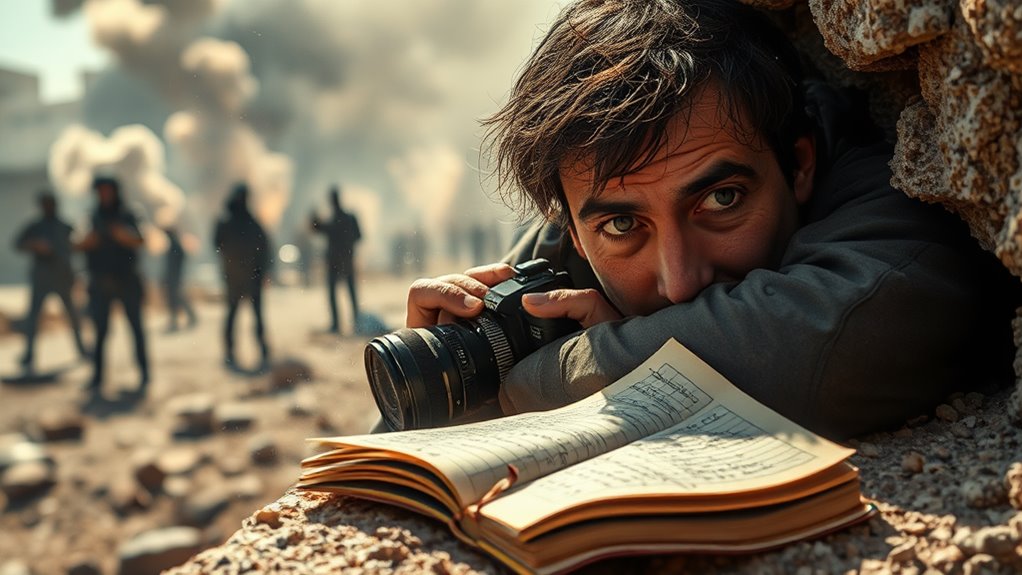
The Challenges Journalists Face in Covering Conflicts
On September 7, 2025 by William GreenJournalists covering conflicts encounter significant challenges that include physical and psychological risks, access barriers, and ethical dilemmas. The unpredictable violence in war zones poses threats of injury or death, whereas exposure to trauma can lead to long-term mental health issues such as PTSD. Furthermore, journalists often face restrictions from governments and militias that hinder their movement and access to essential information. Ethical considerations, including the need for informed consent and sensitivity in reporting, complicate their work further. These multifaceted challenges require journalists to balance truth, safety, and empathy in their important role as informants. More insights await on this pressing topic.
Physical Risks in War Zones
In the chaotic environment of war zones, journalists face significant physical risks that can jeopardize their safety and impede their ability to report effectively. Combat zones are inherently dangerous settings characterized by unpredictable violence, including bombings, gunfire, and the presence of hostile factions. These conditions create a terrain fraught with peril for those tasked with documenting the events unfolding around them.
The frequency of journalist fatalities in these regions underscores the seriousness of the situation. According to various reports, the number of journalists killed during conflicts has increased alarmingly over the past decade. These fatalities often arise not just from direct combat but also from targeted attacks, kidnappings, and accidents related to military operations. The loss of life in these circumstances is not merely a statistic; it represents a profound tragedy that silences important voices and diminishes the public's access to essential information.
Moreover, the physical risks extend beyond the immediate threat of death. Journalists frequently contend with injuries that can lead to long-term disabilities or psychological trauma, such as post-traumatic stress disorder (PTSD). The combination of these threats not only poses a challenge to individual reporters but also raises questions about the integrity and continuity of news coverage in regions where accurate information is critical.
Navigating Misinformation
During reporting from conflict zones, journalists must likewise grapple with the pervasive challenge of misinformation, which can distort the narrative and hinder the quest for truth. In an era where information spreads swiftly, distinguishing between credible reports and misleading claims becomes paramount. Journalists are tasked with not just gathering information but additionally verifying its accuracy through effective fact-checking strategies.
To navigate misinformation effectively, journalists can employ a range of approaches:
- Source Verification: Confirming the credibility of sources before reporting.
- Cross-Referencing: Utilizing multiple reputable outlets to validate facts.
- Engaging Experts: Consulting specialists who can provide clarity on intricate issues.
- Utilizing Technology: Leveraging tools designed to identify and combat fake news, such as digital forensics software.
- Public Education: Raising awareness among audiences about the importance of critically evaluating news sources.
Combatting fake news in conflict reporting is crucial not only for maintaining journalistic integrity but additionally for ensuring that the public receives accurate information. Misinformation can exacerbate tensions and lead to misinformed decisions by policymakers and the general public alike. Consequently, journalists must remain vigilant in their efforts to provide clear, truthful narratives, equipped with robust fact-checking strategies that can withstand scrutiny. By prioritizing accuracy, they contribute to a more informed society, capable of grasping the intricacies of conflict situations without the cloud of misinformation.
Ethical Dilemmas in Reporting
Ethical dilemmas in reporting arise as journalists endeavor to balance the truth with the need for sensitivity toward affected individuals and communities. Furthermore, protecting sources and their identities is vital, particularly in volatile environments where repercussions can be severe. Journalists must likewise navigate the challenge of reporting without sensationalism, ensuring that their coverage respects the gravity of the situation as they remain informative.
Balancing Truth and Sensitivity
As journalists endeavor to provide accurate and thorough coverage of conflicts, they often encounter the ethical dilemma of balancing truth with sensitivity. This challenge is particularly pronounced when reporting on traumatic events that affect individuals and communities profoundly. Striking the right balance is crucial for maintaining a truthful representation during ensuring the dignity of those involved.
To navigate this complex setting, journalists must consider the following:
- Empathy for Affected Individuals: Acknowledge the pain and suffering of those impacted by conflict.
- Contextual Comprehension: Provide background information to help audiences grasp the broader implications of the events.
- Informed Consent: Seek permission from individuals before sharing their stories, particularly in sensitive situations.
- Language Choice: Use language that respects the gravity of the situation during avoiding sensationalism.
- Impact Assessment: Reflect on how the reporting may affect the subjects and communities involved.
Protecting Sources and Identity
Although the protection of sources is a foundational principle in journalism, the intricacies of covering conflicts often lead to difficult ethical dilemmas regarding confidentiality and identity. Journalists frequently encounter situations where their sources are at risk of retaliation, particularly in volatile environments where information can endanger lives. This places immense pressure on reporters to maintain source confidentiality as they seek to deliver accurate and timely news.
In conflict zones, the stakes are heightened; individuals providing sensitive information may require identity protection to safeguard themselves from persecution or violence. Journalists must navigate the fine line between fulfilling their ethical obligations to the public and ensuring the safety of those who provide critical insights. This dilemma is compounded by the potential for legal ramifications if the confidentiality of sources is compromised.
Moreover, the rise of digital communication adds layers of complexity, as the permanence of online records can jeopardize anonymity. As a result, journalists are faced with the challenge of employing secure methods to communicate while being transparent about the risks involved. In the end, the responsibility to protect sources and their identities remains a cornerstone of ethical journalism, demanding constant vigilance and thoughtful consideration from those reporting in conflict situations.
Reporting Without Sensationalism
Despite the urgency of reporting from conflict zones that can tempt journalists to prioritize dramatic narratives, maintaining a commitment to accuracy and restraint is vital. Responsible reporting hinges on narrative integrity, which guarantees that the intricacies of human experiences are conveyed without sensationalism. Journalists must navigate the fine line between engaging storytelling and ethical obligation.
Key considerations for reporters include:
- Avoiding exaggeration: Present facts without inflating the severity of events.
- Highlighting human stories: Focus on individual experiences rather than solely on graphic violence.
- Contextualizing information: Provide background to help readers comprehend the situation's nuances.
- Fact-checking rigorously: Verify information before dissemination to uphold credibility.
- Promoting empathy: Encourage awareness of the broader human impact rather than merely the chaos of conflict.
Access to Conflict Areas
Access to conflict areas presents a significant challenge for journalists, particularly regarding maneuvering restrictions imposed by governments or militant groups. These access challenges can severely limit a journalist's ability to report accurately and thoroughly on the unfolding events. Often, journalists are required to navigate a complex setting of permits, checkpoints, and hostile environments, which can deter them from reaching the frontlines where critical news is generated.
Logistical hurdles compound these difficulties. Transportation may be restricted or compromised because of ongoing fighting, making it nearly impossible to travel safely to conflict zones. Furthermore, limited access to reliable communication infrastructure can impede the ability to send reports back to news organizations in real-time. Journalists may find themselves cut off from vital resources, such as medical assistance or safe housing, which can further complicate their work.
Moreover, the presence of hostile forces can create an atmosphere of fear and uncertainty, forcing journalists to rely on local contacts for guidance and information. This dependency can lead to potential biases and compromise the integrity of their reporting. As a result, journalists must employ innovative strategies, such as remote reporting or collaborating with local freelancers, to overcome these barriers.
Psychological Impact on Journalists
Covering conflicts can impose a significant emotional toll on journalists, as they often witness trauma and violence firsthand. This high-stress environment necessitates effective coping mechanisms to mitigate the psychological effects associated with their work. Comprehending these challenges is essential for nurturing resilience and ensuring the well-being of those who report from the front lines.
Emotional Toll of Reporting
The emotional toll of reporting from conflict zones can be profound, often leaving journalists with lasting psychological scars. The experiences of witnessing human suffering, destruction, and chaos can challenge their emotional resilience and lead to significant mental health issues. Trauma awareness is vital in comprehending the risks journalists face in these environments.
Key factors contributing to the emotional toll include:
- Constant exposure to violence: Repeatedly witnessing traumatic events can desensitize or overwhelm journalists.
- Isolation from support systems: Being in remote areas can limit access to friends, family, and mental health resources.
- Moral injury: Conflicting emotions about reporting versus the desire to help can create profound internal strife.
- Fear for personal safety: The risk of being attacked or kidnapped adds a layer of anxiety to their work.
- Post-traumatic stress: Accumulated stress can manifest as anxiety, depression, or other mental health conditions.
Comprehending these challenges is vital for nurturing a culture of support and compassion within the journalism community. Addressing the emotional toll aids in individual recovery and bolsters the integrity of the profession as a whole.
Coping Mechanisms for Journalists
Finding effective coping mechanisms is vital for journalists who face the psychological impact of reporting in conflict zones. The intense exposure to violence, trauma, and human suffering can lead to significant mental health challenges. To mitigate these effects, journalists are encouraged to adopt self-care practices that prioritize their physical and emotional well-being. This can include activities such as regular exercise, mindfulness meditation, and maintaining a healthy work-life balance.
Additionally, peer support plays an important role in helping journalists cope with the unique stresses of their profession. Engaging with colleagues who understand the demands of conflict reporting can cultivate a sense of community and provide opportunities to share experiences and strategies for resilience. Structured support groups or informal gatherings can facilitate open discussions about emotional struggles, creating a safe space for healing.
Dealing With Censorship
Although journalists endeavor to report the truth in conflict zones, they frequently encounter significant obstacles due to censorship imposed by governments, militant groups, or other entities. This censorship can take various forms, severely impacting press freedom and challenging journalistic integrity. Journalists are often forced to traverse a terrain shaped by government restrictions, where the flow of information is tightly controlled, leading to a media blackout that obscures critical events and perspectives.
The consequences of such censorship include:
- Limited Access: Journalists may be barred from entering conflict areas or restricted in their movements, hindering their ability to gather firsthand accounts.
- Manipulation of Information: Governments and militant groups may disseminate propaganda, skewing the narrative and undermining the journalists' efforts to present an accurate portrayal.
- Threats and Intimidation: Journalists risk threats to their safety or that of their families, which can create a chilling effect, discouraging honest reporting.
- Legal Repercussions: Journalists may face arrest or legal action for disseminating information that contradicts official narratives, further stifling dissenting voices.
- Self-Censorship: The pervasive atmosphere of fear and uncertainty can lead journalists to self-censor, ultimately compromising their ability to report freely.
In confronting these challenges, journalists must balance their commitment to journalistic integrity with the harsh realities that censorship imposes, continually working to uphold the values of press freedom despite the most oppressive conditions.
Balancing Objectivity and Empathy
Steering the delicate balance between objectivity and empathy is a significant challenge for journalists covering conflicts. In the heat of war, where human suffering is often palpable, maintaining reporting integrity while conveying the gravity of the situation can be particularly complex. Journalists are tasked with the dual responsibility of informing the public and honoring the experiences of those affected by violence and turmoil.
Emotional intelligence plays a critical role in this endeavor. It allows journalists to connect with the stories of individuals caught in conflict, nurturing a deeper comprehension of their plight. Nevertheless, excessive emotional involvement can compromise a journalist's objectivity, potentially leading to biased reporting. Therefore, journalists must navigate these emotional waters carefully, ensuring that their empathy does not cloud their judgment or distort the facts.
Moreover, the necessity for objectivity is paramount; it serves as the foundation of credible journalism. Reporting must remain grounded in verified information, allowing audiences to form their own opinions based on an accurate portrayal of events. Striking this balance is crucial, as it impacts the journalist's credibility and influences public perception and response to the conflict.
Ultimately, the challenge of balancing objectivity and empathy requires journalists to cultivate a nuanced approach—one that respects the emotional weight of the stories they cover while adhering to the principles of ethical journalism. This delicate equilibrium is fundamental for nurturing informed discourse and promoting comprehension in an increasingly complex world.
Safety Measures and Protocols
In conflict zones, journalists must implement robust safety measures and protocols to protect themselves from potential dangers. This includes conducting thorough risk assessments, undergoing emergency response training, and adhering to established protective equipment standards. By prioritizing these strategies, journalists can navigate hostile environments more effectively during maintaining their commitment to reporting the truth.
Risk Assessment Strategies
Although the unpredictable nature of conflict zones can pose significant dangers to journalists, implementing effective risk assessment strategies is vital for ensuring their safety. By employing robust risk evaluation frameworks and adhering to established crisis management protocols, journalists can better navigate the intricacies of their environment.
To improve safety, journalists should consider the following strategies:
- Pre-deployment assessments: Conduct thorough research on the conflict area to identify potential risks.
- Real-time monitoring: Utilize technology to stay informed about changing conditions and threats.
- Local partnerships: Collaborate with local reporters and organizations for insights and support.
- Emergency contacts: Maintain a list of emergency contacts, including local authorities and medical facilities.
- Mental health resources: Prioritize mental well-being by accessing support systems for stress and trauma management.
Emergency Response Training
When journalists operate in conflict zones, possessing thorough emergency response training becomes essential to effectively manage crises and safeguard their well-being. This training equips them with important skills such as first aid, enabling them to respond swiftly to medical emergencies that may arise in chaotic situations.
Furthermore, journalists must be proficient in crisis communication, ensuring they can relay critical information to their teams and the outside world during high-stress scenarios. Comprehending how to communicate effectively under pressure not only aids in their safety but also improves the accuracy of the information conveyed to audiences.
Emergency response training typically includes simulations that mimic real-life conflict scenarios, allowing journalists to practice their skills in a controlled environment. This preparation helps them develop quick decision-making abilities and instills confidence in their capacity to handle emergencies.
Ultimately, extensive training in emergency response empowers journalists to navigate the intricacies of conflict reporting while prioritizing their safety and that of others. By investing in these vital skills, they can focus on their role as informants, providing important coverage of events that shape our world.
Protective Equipment Standards
A thorough grasp of protective equipment standards is crucial for journalists operating in conflict zones. Adhering to established safety standards not only improves personal security but additionally cultivates a culture of safety within the profession. Journalists must be well-equipped with the appropriate protective gear to mitigate risks associated with reporting in hostile environments.
Key considerations for protective equipment standards include:
- Ballistic protection: Wearing vests that meet NIJ standards to defend against gunfire.
- Helmets: Using helmets that meet military specifications for impact resistance.
- First-aid kits: Carrying extensive kits customized for trauma care.
- Communication devices: Ensuring reliable communication tools for emergency situations.
- Training certifications: Obtaining training in the use of protective gear and emergency procedures.
Impact of Technology on Reporting
Technological advancements have fundamentally transformed the terrain of conflict reporting, improving the speed and accessibility of information dissemination. Journalists now have immediate access to various digital platforms, enabling them to share breaking news and updates in real time. Nevertheless, this rapid information flow likewise presents challenges, particularly regarding data verification. The ease of disseminating unverified information can lead to the spread of misinformation, undermining the credibility of the reporting.
Moreover, the rise of digital surveillance tools has reshaped the way journalists gather information in conflict zones. Whereas these tools can provide critical insights and situational awareness, they additionally raise ethical concerns regarding privacy and the safety of sources. Journalists must navigate the fine line between leveraging technology for improved reporting and respecting the rights of individuals affected by conflict.
Furthermore, the use of social media as a reporting tool has created new dynamics in information gathering. Platforms such as Twitter and Facebook can serve as real-time sources of information, but they also require journalists to critically assess the authenticity of the content. The challenge lies in distinguishing between reliable sources and potential propaganda or misleading narratives.
Building Trust With Sources
How can journalists effectively build trust with sources in conflict zones? Establishing a rapport with individuals in such volatile environments is essential for accurate reporting and source verification. Trust is not given lightly; it is earned through consistent, respectful interactions and a commitment to ethical journalism. Here are some strategies journalists can employ to nurture this trust:
- Be transparent: Clearly communicate the purpose of your inquiry and how the information will be used.
- Prioritize safety: Guarantee the physical and emotional security of sources, particularly in dangerous situations.
- Engage with the community: Attend local events and establish connections to demonstrate genuine interest in the community's well-being.
- Provide feedback: Share how the source's information contributed to the story, reinforcing their importance in the process.
- Respect cultural sensitivities: Understand and appreciate local customs and values to build stronger relationships.
Frequently Asked Questions
How Do Journalists Maintain Their Mental Health During Prolonged Conflicts?
Charting the tumultuous waters of prolonged conflicts, journalists face unique mental health challenges. To cultivate emotional resilience, they employ effective stress management techniques, such as regular debriefing sessions and mindfulness practices. Establishing a supportive network is crucial, allowing for shared experiences and coping strategies. By prioritizing self-care and recognizing the signs of burnout, journalists can better shield themselves from the emotional toll of their work, ensuring both personal well-being and professional integrity.
What Role Does International Law Play in Conflict Reporting?
International law plays an essential role in conflict reporting by establishing legal frameworks that govern the conduct of journalists and the protection of civilians. Ethical considerations arise as journalists navigate these laws, ensuring their reporting does not compromise human rights or exacerbate tensions. Adherence to international law not merely improves the credibility of their work but additionally promotes accountability among conflicting parties, in the end contributing to more informed and responsible public discourse.
How Do Journalists Handle Personal Biases in War Coverage?
In the tumultuous terrain of war coverage, journalists often grapple with their own personal reflections, which can cast shadows on objectivity. The ethical dilemmas that arise are profound; how does one report the truth during the course of inherent biases? To manage this, many adopt rigorous self-reflection and seek peer reviews, ensuring that their narratives remain grounded in factual reporting rather than personal sentiment. In the end, maintaining credibility hinges on transparency and ethical integrity in their storytelling.
What Support Systems Are Available for Journalists in Conflict Zones?
Support systems for journalists in conflict zones include emergency training programs that prepare them for the risks they may encounter. Organizations such as the Committee to Protect Journalists and Reporters Without Borders provide crucial resources, including funding opportunities for safety equipment and mental health support. Furthermore, various non-profit organizations offer workshops that equip journalists with skills to navigate dangerous environments, ensuring their well-being during promoting responsible reporting in volatile situations.
How Can Audiences Verify the Credibility of Conflict Reporting?
"Trust, but verify" is a wise saying to contemplate when evaluating the credibility of conflict reporting. Audiences can employ fact-checking techniques, such as cross-referencing information with multiple reputable sources, to establish accuracy. Furthermore, source evaluation is essential; scrutinizing the background and expertise of the reporter or organization can provide insight into reliability. Engaging with diverse perspectives helps nurture a more thorough comprehension of the situation, finally enhancing informed judgment.